
A Liberal State: How Australians Chose Liberalism over Socialism 1926-1966
29 April 2022
By: Centre For The Australian Way Of Life
David Kemp chronicles how an ascendant utopian socialism dragged Australia down, until believers in freedom regrouped and fought back.
It is rare to be able to say when a task is 80 per cent complete that it is already a classic, but that is certainly the case with David Kemp’s landmark five-volume historical study of Australian liberalism. Since the first two volumes were reviewed in the Spring 2019 edition of IPA Review, the third and fourth volumes have been published and they confirm what I said then:
The concept of telling the Australian story through the prism of liberalism, whether in the ascendant or under threat, is an inspired one. It is probably fair to say that only David Kemp, with his lifetime of focus on liberal causes as an academic, adviser and member of parliament, could both have seen the potential of such a work and had the knowledge, understanding and writing ability to bring it to fruition.
[the series is published by The Miegunyah Press. More information, here]
Volumes three and four cover the period from Federation until the 1966 retirement of the founder of the modern Liberal Party, Robert Menzies. The dividing point between these volumes is 1925, which means that volume three covers fewer years than any other volume in Kemp’s series. This undoubtedly reflects the fact that the policy battles within liberalism in the first decade of the 20th century were seminal in shaping the nature of the federated Australia for much of the 20th century. These outcomes were compounded by the First World War, which dealt a massive worldwide blow to the liberal ideals which had achieved so much progress in the 19th century. How liberalism survived this threat, and then began to prosper again, is the story of volume four.
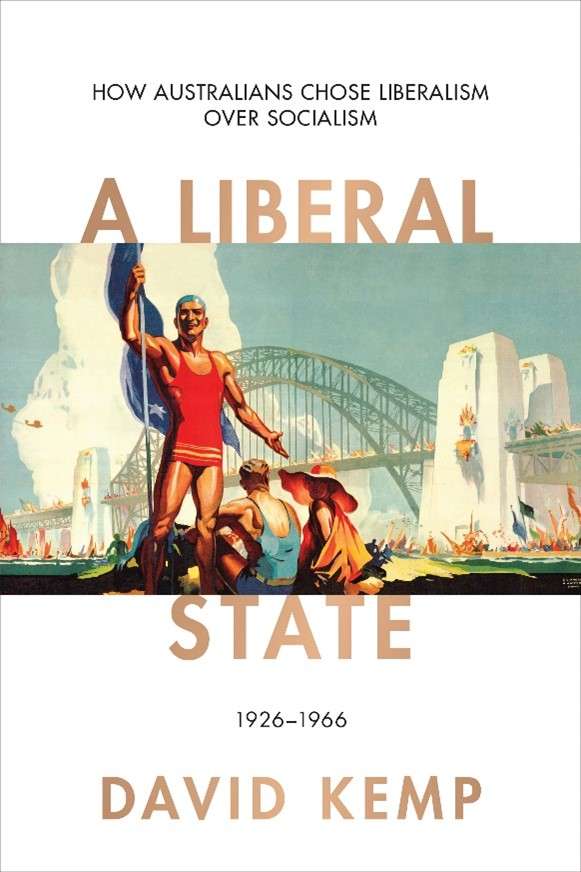
Picking up the story on 1 January 1901, Kemp starts volume three by neatly summarising the situation which faced the newly federated nation at the start of the 20th century.
While a White Australia was the foremost policy priority for the Labor Party, and strongly supported by the Protectionists under Alfred Deakin, the Free Trade movement retained at least some members who appreciated liberal principles. Unfortunately, Free Trade Party leader George Reid somewhat cynically thought that if he conceded to Labor’s demand for an explicitly White Australia, some Labor members might be inclined to support free trade rather than protection once the immigration issue was settled. On the other hand, more principled Free Traders were upset by Reid’s stance, as Kemp notes.
The other manifest failure on race in early 20th century Australia was the treatment of. Aboriginal Australians. Until about 1840 the Enlightenment project suggested equal rights, but then the frontier wars made this seem unrealistic and suggested protection of Aboriginals on reserves as the only viable humanitarian option. However, as Kemp observes, “protection of a race was the opposite of the liberal ideal, for it ignored individual circumstances and laws based on race eroded the rights of citizenship that had been granted, and established what became a bureaucratic tyranny”. Later, Kemp describes how some well-meaning attempts to improve Aboriginal conditions under the Lyons government foundered due to “the intellectual incoherence of trying to balance liberal concepts with concepts of paternalistic protection”. The concept of protection of Aboriginal Australians remained the dominant accepted practice until the 1950s when policy begins to move towards a more liberal approach of trying to provide equal rights and full citizenship.
As volume three ends, Kemp observes that the world’s most democratic constitution had produced “the largest state, relative to its society, in the Western world”, with regulation, taxation, spending and public employment all increasing to “an exceptional degree”. As bad as this was, there were threats of worse to come. Kemp argues that NSW Premier Jack Lang was “the greatest challenge to liberalism in the interwar years”. Lang skilfully developed his brand as an “anti-capitalist populist”, who denied he was a communist yet shared many of their prejudices, and exhibited a racism which was “overt, repeated and anti-Semitic”. Lang and his acolytes posed the greatest internal threat to Australia’s future as a liberal democracy as their pursuit of “socialism in one state” was based on a claim that not only had capitalism failed, but parliamentary democracy had too.
If Lang was the worst of the villains, Menzies was the foremost of the virtuous and his role in the revival of liberalism dominates volume four. Kemp argues Menzies was “the main exponent of the political case for economic and social liberty from the Great Depression, through World War II, and for the first 20 years of the Cold War”.
In Menzies’ long political career, no event was more important than the formation of the modern Liberal Party in 1944. Menzies began the process of revitalising Australian liberalism with a series of radio broadcasts, which have become known to posterity as the Forgotten People talks. Many politicians have used a spell in the wilderness to espouse some sort of philosophical framework to lend gravitas to a potential return. Only Menzies managed to translate his ideas into the formation of a political party representing the aspirations of the Australian people so well.
At times in its subsequent history, one might have doubted the Liberal Party was “a party with a philosophy”, as Kemp titles the chapter on its formation, but it certainly was at the time. Kemp describes the importance of the Institute of Public Affairs (IPA) in contributing to that philosophical development in a period when people treated ideas seriously. At least due to its election victory in 1949, and subsequent electoral success, the Liberal Party halted the socialist advance which had looked to have such momentum in the 1940s.
While Kemp admires Menzies, he also provides criticism where due. For instance, in 1952, when the Menzies Government imposed severe import restrictions to cope with inflation and a balance of payments crisis, Kemp quotes the IPA describing the measure as “a near economic tragedy for the country”. Kemp also notes how some of the wartime restrictions were slow to disappear, even under the Liberal Government.
An important aspect of Kemp’s work is the understanding that liberalism does not operate in a philosophical or political vacuum. The most significant Australian political development in the post-war period was the mid-1950s Split in the Labor Party, which resulted in the formation of the anti-communist Democratic Labor Party that allocated preferences to the non-Labor parties. Kemp takes issue with historian Robert Murray, who argued the Split was “about power and personalities”. Kemp writes Murray “underestimated the significance of ideological and religious loyalties and ideas in this explanation”. As Menzies sought to make permanent the electoral shift in a slice of the former Labor vote, he moved towards providing State Aid to Catholic schools, an issue on which Liberals could also be divided.
The shift in political allegiances triggered by the Split and the introduction of State Aid helped break down the sectarianism which had been one of the negative features of Australian society till that time. This coincided with the decline in the importance of religion and changing social mores. While the full impact of the 1960s social revolution will be felt in volume five, Kemp’s chapter on the ‘new individualism’ in volume four sets the scene for the seismic changes to come. As Kemp notes, “one by one the legislative restrictions on social freedom achieved by the Christian churches in the 19th century in their efforts to moralise society, such as the censorship of literature … criminalisation of homosexuality, prohibition of shopping and sport on Sundays … were to be swept away”.
Kemp links the new individualism with the beginning of what was to be the revival of liberal economic thought, through growing interest in writers such as Milton Friedman and Friedrich Hayek. Once again, Kemp’s own long experience in liberal circles proves to be an invaluable asset, as he describes participating in discussion groups on Friedman and Hayek at the Melbourne University Liberal Club in the mid-1960s. Further signs of green shoots in the liberal revival could be found at the Tariff Board, where during the 1960s it changed from making recommendations based on self-interested industry submissions to considering the impact of Protection for all on the broader economy.
While some might query why the Menzies Government did not do more to open up the Australian economy, there is still plenty to support Kemp’s proposition that “the cultural impact of Menzies’s long period in office was immense”. Kemp argues that, by 1966, Menzies had given Australia “a much more liberal state and liberal political culture than would ever have been predicted at the end of World War II”. This positive assessment clashes somewhat with Menzies’ own pessimism about the state of his Liberal creation in his retirement, a discrepancy partly explained by Kemp having the advantage of being able to place that period within a bigger picture of liberal revival.
The historical understanding provided by Kemp’s volumes demonstrate Australian society is at its best when liberal ideals are nurtured, espoused, and put into action.
This article by IPA Senior Fellow, Richard Allsop, originally appeared in the Autumn 2022 edition of the IPA Review.
For commentaries on other works in the IPA’s Canon, go to the Index at The Genius of Australia.
