
Oscar and Lucinda
7 March 2024
By: Centre For The Australian Way Of Life
Peter Carey, 1988
The Oxford critic John Bayley, the sometime husband of Iris Murdoch, says somewhere, that there are the great novels we remember and the greater ones we forget. Normally this is taken to refer to the vast mimetic grandeur of Tolstoy or, a bit differently, to the infinite diurnal detail and essayistic modulation of Proust, both of them very life-like in their sweeping embrace of the everyday and their massive command of actuality, the forgettable rendered radiant if momentarily. But how does Peter Carey’s Oscar and Lucinda fit into this schema? Do we remember clearly how Oscar ends up and if we do what do we make of the tonality, the way in which what is in fact an exit is executed?
And when the long-awaited white fingers of water tapped and lapped on Oscar’s lips, he welcomed them in as he always had, with a scream, like a small boy caught in the sheetfolds of a nightmare.
What is that scream doing there, we ask, and then we remember that the penultimate moment in this most celebrated of Carey’s novels involves Oscar’s effective rape which is then followed by this ghastly drowning.
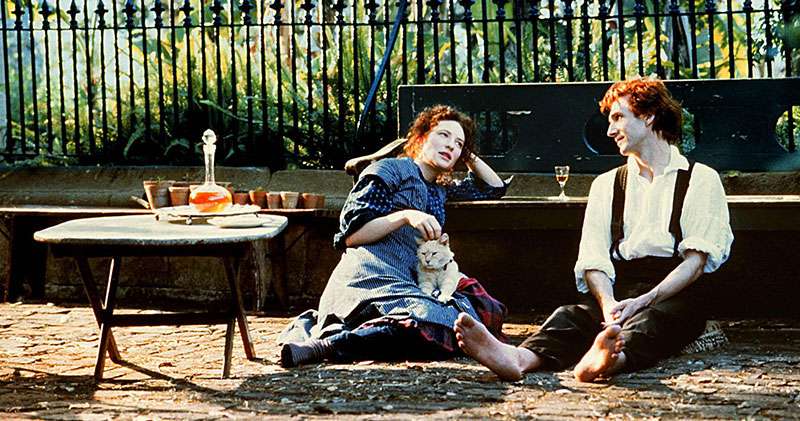
Oscar and Lucinda, published in 1988, won the Booker Prize in Britain, the Miles Franklin in Australia and had the inestimable benefit of being filmed by Gillian Armstrong at precisely the moment (1997) when its two leads Ralph Fiennes and Cate Blanchett had just become stars, even though they were affordable when they were signed up.
But look at the moment when Lucinda (inveterate and impassioned gambler) comes to the Anglican Odd-Bod and miracle gambler Oscar wanting – in accordance with Puseyite AngloCatholic tradition – confession.
“But you have not absolved me.”
“Where is the sin?”
She was shocked, less by what he said, but by the sudden change of mood that took possession of him. He spoke these words in an angry sort of passion quite foreign to his personality. His eyes went hard. He made a jerky gesture towards the cards—ha! he had seen them after all—in front of him.
“Our whole faith is a wager, Miss Leplastrier. We bet—it is all in Pascal and very wise it is too, although the Queen of England might find him not nearly Presbyterian enough— we bet that there is a God. We bet our life on it. We calculate the odds, the return, that we shall sit with the saints in paradise. Our anxiety about our bet will wake us before dawn in a cold sweat. We are out of bed and on our knees, even in the midst of winter. And God sees us, and sees us suffer. And how can this God, a God who sees us at prayer beside our bed …”
His hands were quite jerky in their movements. There was a wild sort of passion about him, and the eyes within that sharp-chinned face held the reflections of electric lamps. Lucinda felt the hair on the back of her neck stand up.
Pascal’s wager is, of course, a proposition that has considerable cultural currency but our memory of Carey’s novel and the general tenor of the film – which is in its way faithful to a fault – is to minimise the way in which a faux naive narrative and dialogic style is steeped in theological atmospheric anxieties.
We know as a fact that one of Carey’s shaping sources is Edmund Gosse’s Father and Son, but the very early dealings of Oscar and his Plymouth Brethren father are fraught with anxiety even though the technique has an artful simplicity. Oscar is terrified of his father, he doesn’t want to break his heart but he also has a passionate desire for some approximation to personal assurance or salvation.
That’s one reason why he finds the local vicar’s wife so disconcerting, because she talks with such disturbing speculative curiosity about the different strands of Christian opinion from Wesley’s radical Protestantism to the near-Papist affirmations of the Oxford Movement. Newman is never mentioned – which is a bit odd given that he is, by general consensus, the most significant figure for English Christianity to throw up since Wesley – and the very use of the term Anglican is ahistorical given that what Oscar is talking about, and what is ultimately to command his loyalty, is one version of the ever shifting doctrinal ground of the established church with all its highs and lows and in betweens, its latitudinarianism, its sometimes modernist denials of literalism like the Virgin birth, the loaves and fishes or what have you.
Carey has set himself to learn these signs and he brings an impressive brio to his representation of a world where people read Wilkie Collins and Dickens, but his technique is that of a rough sketch cartoonist and what makes Oscar and Lucinda so fresh and surprising – and what gives it both its pace and zest – is its ability to present as it were a sub–Classics comic view of its subject matter.
Oscar turns out to have magical powers as a gambler, but it’s interesting that there’s rather more magic than realism in what Carey makes of it. None of which is to deny what graceful lyricism he achieves.
“So,” she said, and looked him boldly in the eye.
His face was not how she had imagined it. She had rebuilt it in her imagination, had made it long and censorious when it was, in reality, doelike, almost pretty, with soft eyes regarding her from beneath long lashes.
“Shall we play?” he asked.
Lucinda blushed.
They played with penny bets… She lost. She felt so light, an airy, dragon-fly wing of feeling.
This is wonderful stuff. Before it of course there’s the chap at Oxford who calls him the OddBod and who introduces him to the world of horses and betting and gambling. The driving logic of the book is that Oscar and Lucinda have to wrestle like lovers through the obsessive gambling they indulge in with the blessing of all the confusions that faith and hope (and not a little charity) can engender.
Ultimately, there is the logical corollary – well, the dream corollary – whereby Oscar is entrusted with the glass shell of a church which is to be transported to some fantasticated Australian showplace.
The idea is mad as all get out and it has produced some quite harsh put downs. The most eminent of New Zealand critics C.K. Stead said the first movement of Oscar and Lucinda was like the dirty old man with the lollies: the lollies were nice but what followed was disgusting.
The fragility of all the glass bearing Church stuff in the novel is in fact highlighted in the film which does everything in its power to retain the all but total confusion of the book’s narrative line without the symbolic aroma of how these things work to the extent that they do in the book. The upshot of Gillian Armstrong’s film is a somewhat cumbersome film of what everybody concerned takes to be a classic, though there is no clear sense of why in particular anything is happening at any given movement because it has lost the symbolic dimension, the projected mythology in which the novelist Carey has made a provisional and hypothetical, a gambler’s act of faith.
You go back to the film to be reminded of the story and what you’re confronted with is its skeleton but not its substance. Both Blanchett and Fiennes act with a sort of stifled magnificence but in some ways the most notable thing about the film is that Richard Roxburgh is given black hair and a moustache which makes him like a leading man which eluded him as everything from Hamlet to Roger Rogerson. Geoffrey Rush lends his authority to the narrator who is descended from the unholy coming together. The overall difficulty though with this 1997 film is that it’s a bit like one of those films of a Dickens’ novel which is in fact slowed down by the effort to cram in as much as possible for the sake of comprehensiveness.
It also has to be admitted that the film seemed rather plainer sailing when the book or the idea of the book was clearer in the mind’s eye and there was an air of revelation rather than classics revisited. Still, it’s bizarre that you have to pay $14 to watch the movie on Apple TV.
Peter Craven, literary critic and commentator, co-founded the literary magazine Scripsi, and was founding editor of the Black Inc. Best Of annuals and of Quarterly Essay.
