
Politics is an inside job.
11 March 2025
By: John Roskam
New research on parliamentarians’ backgrounds shows exactly what you’d expect.
I would rather be governed by the first 2,000 people in the Boston telephone directory than by the 2,000 people on the faculty of Harvard University.
William F Buckley Jr
Years ago I wrote a column, ‘In defence of Ricky Muir’. You might remember him (or maybe not). Muir was a senator for Victoria from the Australian Motoring Enthusiast Party. Elected in 2013, a double dissolution ended his parliamentary career after only two years.
Famously, he was elected with 17,122 first preference votes out of a total of 3.3 million Senate votes cast in Victoria. Thanks to the magic of the Senate voting system in place at the time, his 0.51% of the vote got him into parliament ahead of candidates with many more votes (e.g. Family First 52,000 votes, The Wikileaks Party 42,000 votes, and Palmer United Party 124,000 votes).
I didn’t know Muir, I’d never met him or spoken to him, but I liked his maiden speech in parliament.
Today, as I present this speech to you all, I am wearing a suit. Before 7 September 2013 [the date of the election], I did not own a single suit and I had no intention of ever owning one…
By the time I was 15, nearing 16 years old, my focus on schooling was minimal at best and a struggle at worst… I knew what I wanted to do; it was not to enter a long course of expensive education to become a lawyer, a doctor or a political apparatchik. I wanted to work in earth moving, or on a farm, or in manufacturing, a factory, or as a mechanic, with tools – to wear stubbies and his-vis and have the constant pale shade of a single embedded on my otherwise tanned skin. I was not afraid to do manual labour and had no interest in earning millions. I just wanted to be able to support myself and enjoy some of the things that I had previously missed out on.
During this period I learned firsthand how hard it can be to find employment as a young school leaver and had to find ways to be able to better present myself to employers in an effort to at least land an interview.
A few weeks before he commenced his parliamentary term, Muir gave an interview to Mike Willesee, that in the trade, they call a ‘car crash’.
WILLESEE: Do you understand what balance of power means?
MUIR: Yes, that’s the potential if…ah… Say in this case Labor and Greens (long pause)… It’s the power to vote down legislation in the right circumstances.
I said in my piece that Muir was more representative of the mainstream of the Australian public than most politicians we elect. I concluded:
A cabinet full of Ricky Muirs couldn’t be any worse than a cabinet full of Gillard government ministers.
In his maiden speech Muir said ‘Our Senate and the decisions which govern our lives should not be solely represented by the political class.’ Research released today from my colleague at the Institute of Public Affairs, Morgan Begg reveals that Muir’s hope was not be. Australian politics is increasingly dominated by the political class – and Morgan’s analysis proves it.
‘The Rise of the Insiders: The decline of mainstream Australians in the Commonwealth Parliament from 1901 to 2025′ is a ground-breaking audit of federal MPs’ occupational and educational background since federation. These are some of its key findings:
- In 1901, 15% of Commonwealth parliamentarians were ‘insiders’. Today, 60% are ‘insiders’.
- 82% of ALP parliamentarians are ‘insiders’, compared to 37% for the Coalition.
- Only 3.5% of all parliamentarians worked in a working-class occupation before parliament, compared to the 27% of the Australian labour force employed in working-class industries. In the 1950s one-third of parliamentarians had a working class background.
Proportion of all Commonwealth parliamentarians whose immediate prior employment was as an ‘Insider’ or ‘Outsider’.
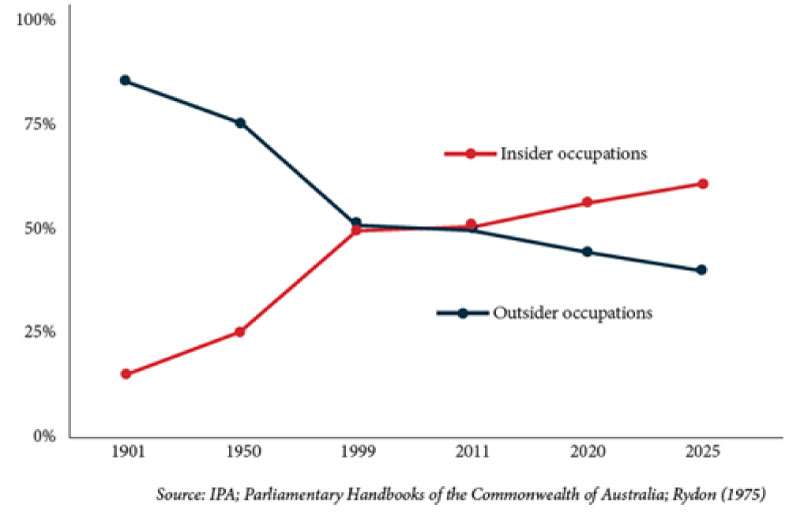
Source: IPA; Parliamentary Handbooks of the Commonwealth of Australia; Rydon (1975)
‘Insiders’ are defined as those who have worked either in politics (e.g. as a political staffer) or in occupations closely connected to politics, directly or indirectly (e.g. a trade unionist, lobbyist, some public servants, a role in publicly-funded research). ‘Outsiders’ are those in the private sector where the connection to politics is through the effect of policies or regulation.
77% of parliamentarians have a university degree, compared to 32% of the Australian population aged over 15. For me the most worrying statistic is this one. Parliamentarians have on average 1.6 university degrees. Or put another way – your average federal MP hasn’t been brainwashed at university just once – they’ve been indoctrinated once and then some.
Morgan writes:
The professionalisation of the political parties has embedded in all parties apparatchiks who dedicate their time to party management, including of endorsement and preselection processes, while the role of regular party members is diminished. The consequences of these changes are that while Australia practices many of the rituals of representative democracy, such as periodic elections, the health of our representative democracy is not secure.
Rather than the community electing representatives of the community, parliamentarians are increasingly already members of the political class prior to entering parliament. Indeed, being an insider is now increasingly a prerequisite for election to parliament.
You can read ‘The Rise of the Insiders’ here.
Someone who has spent twenty years climbing the greasy pole of factional intra-party politics to become a minister and knows nothing other than politics isn’t likely to rock the boat, take risks, or tell the public the truth (if truth-telling risks not being re-elected). All of these factors explain the current state of Australian politics and policy. In The Australian Financial Review last week there was this news:
Australians’ living standards have not increased at all over the past year and are barely higher than they were 10 years ago… Despite the uptick last quarter, real income per person is actually slightly lower than it was one year ago and only 1.5 per cent higher than it was a decade ago – the weakest 10-year growth since records began in 1983, according to analysis by The Australian Financial Review.
This should have been a huge story – but both political parties conspired to bury it. The Coalition didn’t want to talk about it because they’d been in government for seven of the last ten years, and the ALP didn’t because it is clueless about how to raise people’s real incomes. In the absence of a plan – from anyone – it’s not a surprise a Newspoll survey published today found that 80% of voters support higher government spending even if it means higher interest rates. And the Labor Party has responded – the Albanese government has increased government expenditure by 2% of GDP.
In The Australian on the weekend, Paul Kelly expressed his view on all of this.
…election 2025 shapes as a dispiriting project with neither the Albanese government nor the Dutton opposition confronting the challenges the nation faces…
Apart from a few concessions neither Anthony Albanese nor Peter Dutton seem capable of putting an agenda to the public that is fit to meet the disruption, opportunity and transformation lying ahead…election 2025 looms as one of the most irrelevant, insubstantial and uninspiring for many decades because the main parties – Labor and the Coalition – are decoupled from the realities of the times. [There is no better evidence of this ‘decoupling’ than Anthony Albanese making the signature policy of his first term the Voice referendum.]
Don’t fall for the myth this election is a great battle of ideology and ideas. The rhetorical differences are huge and the policy differences are minor, energy aside. [Although I’d argue that for as long they both remain committed to Net Zero, the differences between the major parties on energy policy are minimal.]
Any second Albanese term will duplicate and follow the first. It’s the status quo – but the status quo is heading into a dead end.
The Coalition, meanwhile, is shy of putting its policy money on the table… The fear is the long wait will be followed by a deeply insubstantial policy agenda.
For good or for ill, Australia’s parliamentary system is unlikely to produce a Trump. And it was Trump that I talked about in my Financial Review column last Friday. I don’t normally cover foreign policy, but all the overwrought commentary about Trump and his commitment (or lack thereof) to America’s allies prompted me to write about the historical record of U.S. presidents and their ‘friends’. The record isn’t pretty. There are many grounds to disagree with Trump’s foreign policy. Still, the claim that somehow his behaviour is any different from that of many other presidents and that, as Bret Stephens put it in The New York Times, ‘Roosevelt and Reagan must be spinning in the graves’ is just wrong.
This is some of what I said:
Of course, America is a fickle ally. It’s been so in the past; it will be in the future, and it doesn’t matter who the president is. Surprisingly, it took the scenes at a meeting between Donald Trump and Volodymyr Zelensky for Australians to realise these things.
It doesn’t diminish the valour of the Ukrainians’ resistance against Russia or Zelensky’s incredible personal bravery to point out that the sort of security guarantees he was seeking from Trump have been refused by every U.S. president back to Bill Clinton.
In 1994, Ukraine gave up its nuclear weapons in exchange for commitments from the NATO powers that they would act to secure Ukraine against Russian aggression. Those commitments were never honoured. No Western leader has wanted to provoke war with Russia – and Trump is no exception. American presidents don’t mind starting small wars; the big ones, they try to avoid.
Harry Truman was a great American president. His Marshall Plan saved much of Europe from starvation after the Second World War. But there were lines he would not step over. He decided that war with China was too high a price to pay to unify Korea. When General Douglas MacArthur wanted to expand the Korean War into China, Truman sacked him. Omar Bradley, the chairman of the Joint Chiefs of Staff, didn’t want to fight ‘the wrong war, at the wrong place, at the wrong time, and with the wrong enemy’.
…when it comes to American presidents wanting their money back for services rendered, Trump is doing to Zelensky what Franklin D. Roosevelt did to Churchill in World War II. Britain finally paid off the last of its war debt to the United States in 2006.
Roosevelt was more comfortable dealing with the murderous dictator Joseph Stalin than with Churchill, the democratic leader who, by force of will, saved European civilisation. American presidents were not friendly to the Poles in 1945, to the Hungarians in 1956, or to the Czechs in 1968. The list could go on. The abandonment of the South Vietnamese is a separate story. As is the tale of America in the Middle East and Afghanistan.
As fickle as American presidents have been to their friends and allies for more than a century, the U.S. is – and will be – Australia’s best ally for the foreseeable future. America is our only ally capable of helping Australia secure itself against a potential superpower aggressor. So it’s reasonable for Americans to see the proof that Australia is serious about its defence spending. Three per cent of GDP is the new baseline. Currently, Australia spends 2 per cent of its GDP on defence.
Shared values between allies are good. But shared interests are better. Australia’s geopolitical challenge is to ensure that Trump and the presidents who follow understand that the US-Australia alliance, with all it involves, is in the interests of both countries.
Thank you for your support.
kind regards John

