
At St Columba College on Election Day
9 May 2025
By: John Roskam
Thoughts on the Coalition disaster.
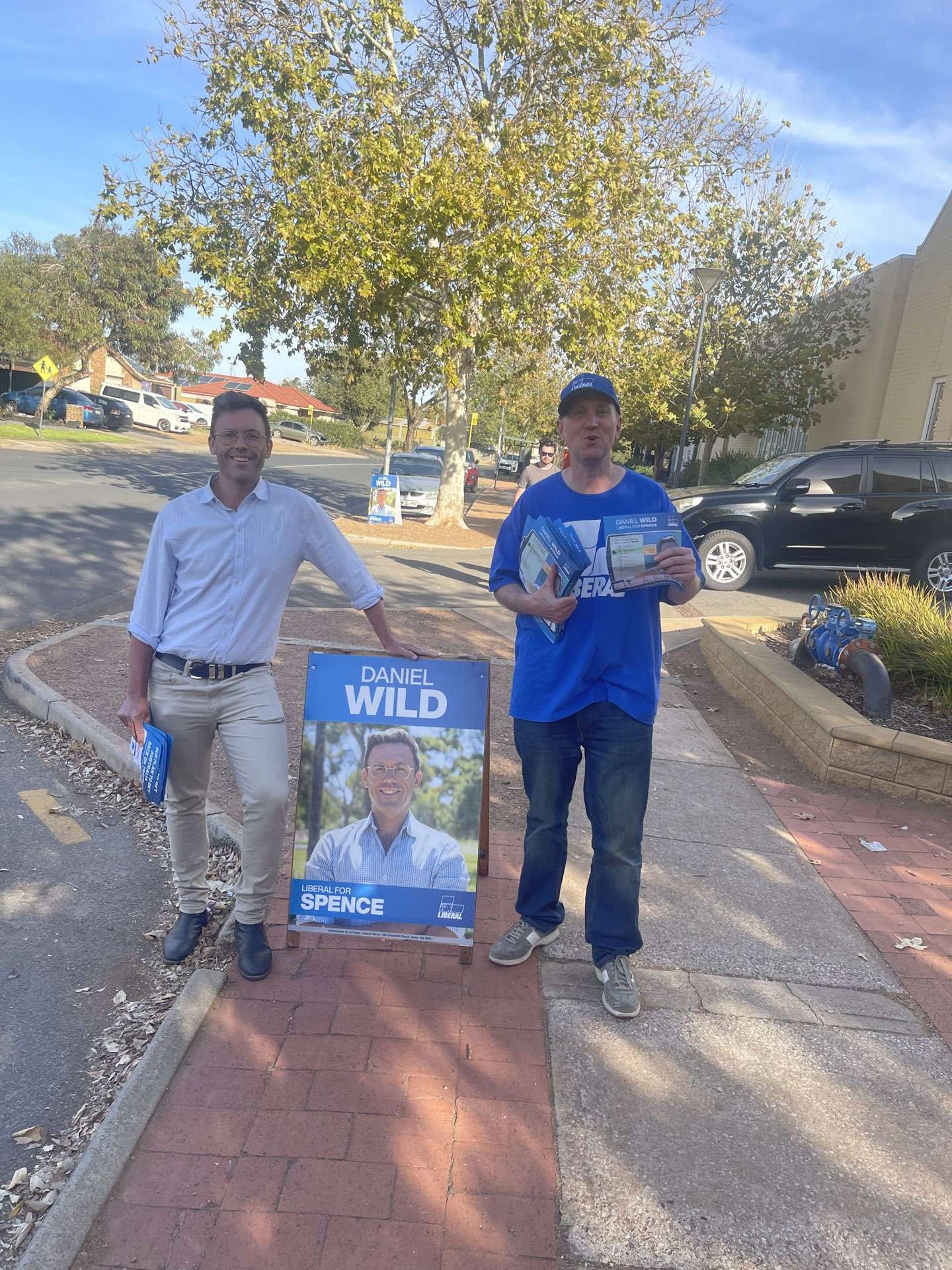
At St Columba College with the candidate.
I spent last Saturday on the polling booth at St Columba College in Andrews Farm in the northern suburbs of Adelaide. I was handing out How To Vote cards for my colleague at the Institute of Public Affairs, Daniel Wild who was the Liberal candidate for the seat of Spence. Before the weekend’s result Spence was a very safe Labor seat. And it still is. Spence is one of the country’s poorest electorates. Of Australia’s 150 lower house electorates, Spence has the 13th lowest median household income.

Fighting to get Australia Back On Track
The highlights of Daniel’s campaign were visits to the electorate by Tony Abbott and Senator Jacinta Nampijinpa Price and Daniel’s promise to give everyone an Australian flag. Pride in Australia, pride in our history and hope for the future were central themes in Daniel’s campaign. You could tell he had Labor worried because Labor started running ads attacking him personally. Probably the best proof of Dan’s impact was that the Labor How To Vote card had a picture of his opponent standing in front of a big Australian flag. Not three flags. Just one. The No vote in Spence at the Voice referendum was 72%, the highest of any Labor-held seat in the country.
Dan’s hard work paid off. He didn’t win, but in a state where the Liberals got smashed (the swing to Labor in South Australia was 5.5% compared to the national swing to Labor of 2.5%) Dan suffered the smallest swing. The swing to Labor in Spence was 2.51%, while in surrounding seats it ranged from 3% to 7%. At St Columba 314 people voted for Liberal (compared to 989 who voted Labor). I like to think that those great 314 Australians who supported Daniel laid the foundation for Spence one day becoming a Liberal heartland seat.

Zelda wasn’t allowed to vote.
Here are some of the things I’ve been thinking about since Saturday.
What happened wasn’t a surprise. I put money on it.
I’m not a big gambler but from time to time I’ll have a bet on the three main sports I follow – the AFL, the English Premier League, and the world championship of darts. Occasionally I’ll bet on politics. At this election I placed two bets of $20 each. I made them on Wednesday night; the first was on Tim Wilson winning Goldstein. I worked with Tim at the Institute of Public Affairs for many years; he’s a friend; he had spent two years campaigning, and Zoe Daniel was terrible. When Melbourne’s Jewish community needed her support she was nowhere. She spent all her time attacking the Liberal Party when it wasn’t even in government. I grew up in Goldstein, my mother lives in Goldstein, and the people of Goldstein know that Daniel is all about Daniel, not the needs of the electorate. I got back $42 on my bet, a profit of $22.
I’ll end up making a profit of $2 on the federal election because my second bet will lose. My second bet is the sort of bet I make when I bet against my AFL team, the Western Bulldogs. I want the Western Bulldogs to win, but if they don’t, at least I get the cash.
I bet on the Coalition winning between 51 and 55 seats at odds of $5.50. The Coalition started the campaign with a notional 57 seats, so I was betting on the Coalition losing seats – I just didn’t think it would lose as many as it did. It’s been reported in the media that in the last days of the campaign, the Liberal leadership genuinely thought they would win up to ten seats. That was utterly delusional and reveals how out of touch with reality the Liberals were. As of tonight the best the Coalition will end up with 45 seats.
The point of telling you this is to make the point that even someone like me, who had no access to private polling and no inside information could feel what was about to befall the Coalition. It wasn’t that hard. Although, as George Orwell said ‘To see what is in front of one’s nose needs a constant struggle’.
By the Wednesday before election day, maybe it was too late for the Coalition to do anything to save itself, but maybe if Peter Dutton had spent the last few days of the campaign in Brisbane, he could at least have saved his seat.
This was reported today:
Peter Dutton visited 10 seats on three occasions or more during the election campaign and failed to win any of them, while Anthony Albanese made more visits than the opposition leader to 11 of the 12 seats that Labor picked up from the Liberal Party last Saturday. The opposition leader did not campaign in eight of the 12 seats his party surrendered… The one seat the Liberal Party has definitely gained at this election was Teal-held Goldstein in Melbourne’s inner south, which the opposition leader visited once – on election day.
Maybe Tim Wilson won Goldstein because Dutton didn’t go near it – and by the time he did, half of the people had already voted.
(Another result that was one of the election’s few bright spots was the defeat of Greens leader Adam Bandt in the seat of Melbourne. At his farewell press conference, he blamed his loss on the decline in the Liberal vote, which pushed the Liberals into third place behind The Greens and the ALP and resulted in Liberal preferences helping elect the Labor candidate. Given Bandt has spent his political career fighting the Liberal Party and one of the Greens’ election slogans was ‘Keep Dutton Out’, it’s a bit rich of him to complain about achieving his objective. And don’t forget it was Liberal Party preference that first got Bandt elected to parliament in 2010.)
The Coalition campaign was a disaster.
Too many Liberals are pretending nothing much is wrong with their party and all they need to do for next time is have a few more policies, pick a different colour for their posters and have a better slogan. No. No. No. I’m a Victorian and it’s that sort of thinking that has seen the Victorian Liberals not just lose the last three state elections – they got thrashed each time. (Based on the weekend’s results, if nothing changes, the Victorian ALP is in line to win four elections in a row.)
Dutton’s apparent election-winning lead at the beginning of the year was always illusory. The polls showing the Liberals ahead reflected a general unhappiness with the world and with whoever happened to be in government at the time – it didn’t reveal a love for the Liberals. You might not like either of the major parties, but in our system of compulsory voting, eventually, you’re going to have to choose either arsenic or cyanide. (Many Australians tried to avoid that invidious choice. Only 81% of eligible voters voted, compared to 90% in 2022 and 92% in 2019. It’s the lowest turnout since the introduction of compulsory voting in 1924. The next lowest turnout was in 2022.)
The problem with a disastrous loss such as the Coalition suffered is that it has consequences for next time. A federal election is not a football game. In a football game, after a team loses to an opponent, when it plays that opponent the next time, both teams start again at zero. The score from the previous game doesn’t matter. At federal elections, the previous score matters because the more MPs a party has in parliament, the greater its capacity to influence future election results. In AFL parlance the Coalition lost the 2025 election by 100 points and they’ll start the 2028 election 100 points behind Labor. At the 2028 federal election, one side must win 76 seats to form government. Labor will start with about 95 seats and the Coalition with about 45 seats.
The Coalition was NEVER EVER going to win a ‘cost of living election’.
From the moment Albanese declared ‘this was a cost of living election’, the Liberals should been suspicious. Instead of asking themselves questions like, ‘Why do they want to make this a cost of living election?’ and ‘What do they know that we don’t?’ the Liberals fell for Labor’s ploy hook, line, and sinker. Labor defined the central contest of the campaign as who would provide the most cost of living relief: Anthony Albanese or Peter Dutton? That was a competition Labor was always going to win. More government spending and more welfare handouts are key elements of the Labor Party brand. The Liberal Party brand (as much as it still has one) is about being on the side of big business, believing in smaller government and lower taxes (more in theory than in practice), less regulation, and more personal responsibility. Nothing in the Liberal Party brand suggests the Liberal Party could win a ‘cost of living election”.
The ALP slogan ‘When Peter Dutton cuts, you pay’ was pretty good. Equally effective for the ALP would have been, ‘The Liberals hurt you. Labor helps you.’
Of course your opponent wants you to fight them on their territory. Did the Liberals ever stop to ask themselves why when Peter Dutton talked about Welcome to Country ceremonies at ANZAC Day commemoration, a succession of Labor ministers lined up to say, ‘Let’s not talk about culture wars and let’s talk about cost of living instead’? The more your opponent (and the left-wing media) don’t want you to talk about something, the more you should talk about it.
This is not said in hindsight. Here’s what I wrote a month ago at the beginning of the campaign.
In the absence of an alternative narrative, the Liberals are reduced to emphasising relatively minor policy differences while leaving unchallenged the central premise of Labor’s campaign, which is that the problems caused by higher government spending will be solved by even more government spending.
In my email to you last week, I quoted Chris Mitchell, ‘Dutton has been playing on Labor’s turf by surrendering to the free money mentality.’ If, as both the Liberal and Labor parties kept on claiming, the number one issue of the campaign was the cost of living, you’d be mad not to vote for the politician promising to give you the most money – and that side was Labor. Whatever relief the Liberals were promising was temporary. The ALP’s tax cuts, as tiny as they were, were permanent.
So could the Coalition ever have won the 2025 election? Of course it could have. There were two things the Coalition needed to do.
First, the Coalition had to frame a response to the cost of living crisis in an entirely different way from Labor’s response. The Coalition needed to explain that Labor’s spending was unsustainable, that Labor’s short-term measures would make things worse, not better, and that the Coalition had A BETTER PLAN FOR THE FUTURE. While Labor and the Coalition focused on the immediate issues of the cost of living crisis, neither side ever discussed growing the economy and ensuring Australia’s future prosperity.
Second, the Coalition needed to talk about more than just the cost of living. Labor succeeded in convincing Peter Dutton that if he mentioned something other than the cost of living it would signal to the public the Coalition wasn’t serious about fixing the cost of living. That’s how clever the Labor Party is.
There was no mention from the Coalition, for example, of education – which is just how Labor would have wanted. The Coalition had a very good school education policy released two days before the election. Labor’s so-called ‘Gonski’ reforms have failed to lift education standards, teachers are leaving the profession in droves, and even Noel Pearson says that the National Curriculum should be reformed. Yet the only thing Dutton said about education during the campaign was in a passing reference to the ‘woke’ curriculum, which he then promptly backtracked from by saying the Coalition had no plans to reform the National Curriculum.
This was a news story in The Australian on Friday, the day before the election:
Curriculum concerns take a backseat to cost of living, says Dutton
Peter Dutton says he toned down his language on the school curriculum because voters are focused on the cost of living. The Opposition Leader on Thursday appeared to walk away from his earlier suggestion school funding to states and territories would be tied to removing ‘an agenda that come out of universities’.
He was asked on Friday morning why he had ‘backed away’ from that position. ‘I think the focus in this campaign has been the cost of living,’ he told ABC FM. ‘It’s been cost of electricity, the cost of gas, all of which goes up under Mr Albanese if he’s re-elected.’
‘We’ve concentrated on the issue that the Australian people have asked us to concentrate on, that is cost of living, housing affordability, and keeping us safe, and they’re the priorities and you’ll see that consistently in the research, but it’s consistent as we knock on doors and speak to people in marginal seats and right across the country and they’re the priorities that they’ve asked us to concentrate on.’
There’s so much wrong with that it’s hard to know where to start. Dutton was doing EXACTLY what Labor wanted him to do. It’s like he was reciting Labor’s talking points. Was Dutton really saying he didn’t want to talk about education so he could talk instead about his policy of a temporary reduction in the price of a litre of petrol by 25 cents? Was he really saying he can’t talk about both things at the same time? Was he really saying that plummeting education standards aren’t important enough to get a mention in an election campaign?
A campaign based on ‘the research’ rather than principles and values was always going to end in disaster – and it did.
Australia’s multicultural communities voted decisively against Peter Dutton and the Coalition. Education and values would have been a way for the Coalition to connect to the parents in those communities – but that wasn’t going to happen because Dutton only wanted to talk about the cost of living. Parents who are newly arrived in Australia didn’t come to the country to have their three-year-old children in preschool indoctrinated in radical gender theory. Maybe that’s something Peter Dutton could have pointed out. Let’s say Dutton had said some time during the campaign that he believed that at the start of every school day, primary school students should sing the national anthem. (Which is what we did at Woorana Park Primary in Dandenong in Melbourne in the 1970s. Am I harking back to a different time in Australia’s history? – yes, I am. Do I think we should return to some of those past practices ?- yes, I do.) If Dutton had said something like that, would all hell have broken loose? Absolutely. Would the ABC have yelled, ‘Liberals start a culture war’? Definitely. Would it have been a fight Labor wanted to have? No. Would the Australian public have supported Dutton? Yes. Would Dutton have shifted votes? Maybe.
The Liberals weren’t ‘too right wing’. They weren’t anything.
A few days ago Penny Wong claimed the Liberal Party ‘doesn’t represent middle Australia’ and was too focused on the culture wars. Labor’s capacity and willingness to rewrite history is breathtaking. The unashamed brazenness of Wong’s remark is almost something to behold. The biggest culture war waged by a political party this century was the Voice. And mainstream Australians overwhelmingly rejected the Voice.
I struggle to come up with a single thing on which the Liberals were ‘right wing’.
They certainly weren’t right-wing on economics. John Kehoe, the Australian Financial Review economics editor, wrote this on Wednesday.
The Liberal Party ran the most left-wing economic agenda arguably since Malcolm Fraser’s embrace of big-government and industry protectionism in the 1970s. Peter Dutton’s team defied basic liberal economic principles and was punished by voters.
Foolishly, Liberals – the supposed party of lower taxation – opposed Labor’s piddly income tax cuts and pledged to impose higher income taxes.
The Coalition was ‘Labor lite’ on spending, matching most of the Labor’s big debt-funded outlays on Medicare. It refused to countenance cutting the out-of-control $50 billion National Disability Insurance Scheme. Dutton’s team supported Anthony Albanese’s spending because it feared Labor’s highly effective “He cuts you pay” slogan.
But imagine if the Coalition had flipped this by proposing income tax cuts, or indexation of the taxation thresholds. ‘We cut your taxes, and you pay for Labor’s higher spending and debt’ could have been the retort.
On culture, the Liberals most definitely weren’t ‘right wing’. The Liberals hid from any debate about culture for fear of being labelled ‘culture warriors’. Peter Dutton’s three different positions on Welcome to Country ceremonies on ANZAC Day over the course for four days doesn’t look to me like a leader pursuing a culture war.
This week Janet Albrechtsen had a brilliant piece in The Australian this week about the Liberals and the culture wars they don’t fight.
Every time the Libs lose a federal election, it’s painted as an existential crisis and critics announce the Libs must stop engaging in the culture wars.
Rubbish. Genuine Liberals need to stop trembling about these ‘culture war’ accusations from opponents, inside and outside the party.
Everything is about culture. What kind of country do we want to live in? If Liberals don’t start embracing that, explaining policies through the prism of what kind of culture we want, they may as well fold their tent and save donors a heck of a lot of money.
What is remotely warlike, or even scary, about debating whether we want more regulation of small business – or less? That’s one about our business culture… Do we want a culture that creates equality of opportunity or equality of outcome? These are very different. The former empowers individuals. The latter empowers the state.
… do we think people should be able to express their views freely without being labelled racist or misogynist or transphobic unless they are inciting violence? Or do we want to crack down on speech with ‘hate speech’ laws, even if those laws may be exploited by people who simply hate the speech of their opponents? That’s another important debate about the culture of freedom in our democracy…
It’s passing strange that the same people who use the term’ culture war’ will talk heartily about the importance of culture when they’re talking about things they support. The arts, for example, as a central part of our culture, should be supported with public funds, they will say. I agree, up to a point. Even if I disagree with them, that doesn’t make our disagreement a culture war. It’s just a disagreement. Debates sharpen ideas. Shutting down debates allows dumb ideas to flourish, untested. It’s as simple as that.
If the Liberals let go of liberal values, shy away from big debates about these values or fail to articulate them effectively to voters, the party will face a genuine existential crisis. There is a rich choice of left-wing offerings on the table for voters. If the Libs join that cultural chorus line, why would voters side with a Labor-lite when they can have the real Labor Party?
On that note I’ll leave it there for today. There’ll be much more to say about all these things in the days and the weeks ahead.
Thank you for your support.
kind regards John
PS – One & Free now now has nearly 5,000 subscribers. Please feel free to forward my emails.

