
Johnno
13 August 2025
By: Centre For The Australian Way Of Life
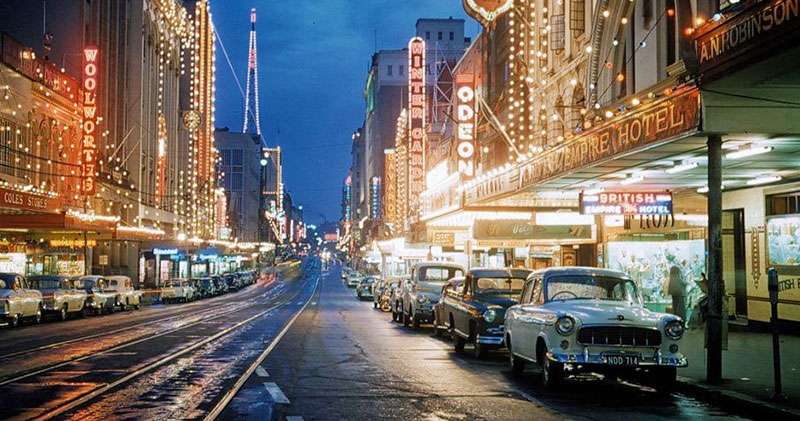
Main image: Queen St, Brisbane, 1959, State Library of Queensland
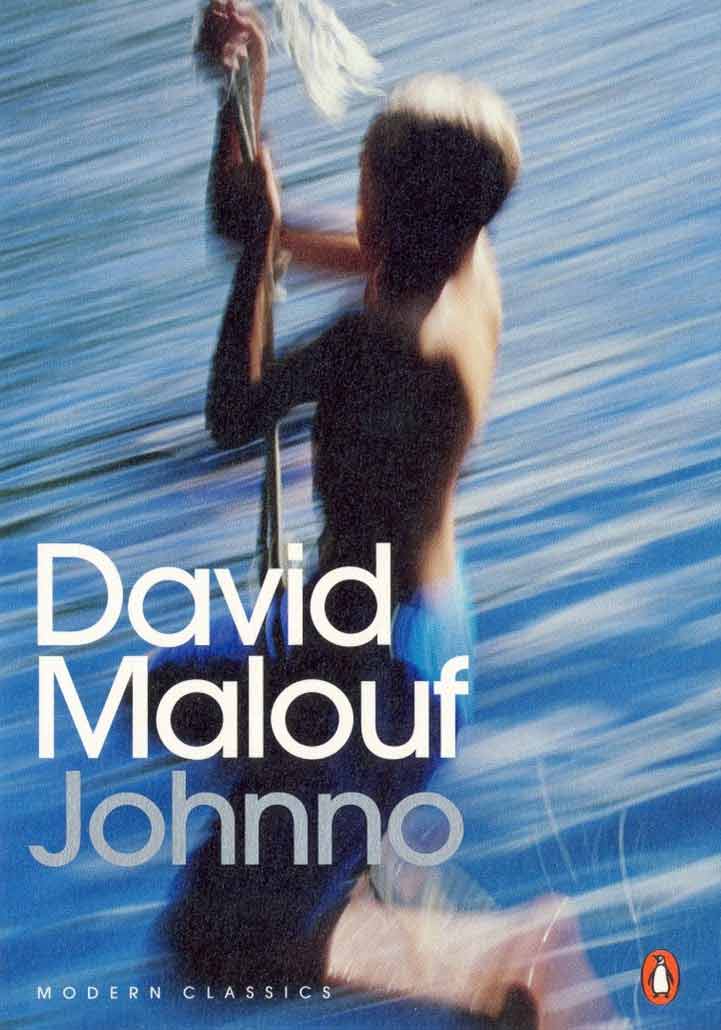
David Malouf, Johnno, 1975
David Malouf (1934 - ) published Johnno 50 years ago when he was 40 and you can still argue it is the finest thing he ever wrote. This is not to decry the ravishing cadences of An Imaginary Life—his story of the poet Ovid and his encounter with a Wolf boy which will bear comparison with Thomas Mann or Gide at their most lyrical and intense—but there is a sense in which Johnno is Malouf’s God-given book, the one in which he tests the limits of what prose can do when it traces the contours of memory and how much a book which starts as a kind of essayistic memoir takes on an indelible power of fiction, of the imaginative truth that underlies a sense of reality apprehended in all its untidiness. It is not exactly a love story though it is full of the plangency of the depths of friendship—yes, as Oscar Wilde said, more tragic than love because it lasts longer—and it is a strange bewilderment of a book because it presents an unforgettable central figure who is constantly competing to present himself as a fictional character, a man who can live through the poses he assumes yet these have a desperate quality that is not separate from their comedy.
So let us start at the book’s end, which gives us the flickering grandeur of the most vivid character in David Malouf’s fiction, the figure who made him the writer he became:
“It’s all lies,” Johnno would say. And in the end, perhaps, it is. Johnno’s false disguise is the one image of him that has lasted, and the only one that could have jumped out from the page and demanded of me these few hours of my attention. Maybe, in the end, even the lies we tell define us. And better, some of them, than our most earnest attempts at the truth.
David Malouf is a realist who believes in the imagination, and he presents this apprehension with a kind of cobbled together awkwardness of narrative line that has, however trickily, the absolute ring of truth.
You can talk about affinities and hypothetical influences. Dante—the narrator—and Johnno the tragicomic fiction of a character have a bit in common with Nick and Gatsby just as Aschenbach and Tadzio have with the central duo in An Imaginary Life, but the parallels do not take us far. Johnno captures Dante’s attention because of a picture of a swimming team in which the tearaway boy does not belong. Our narrator is in his 30s now and his father (“one of the fittest men I have ever known”) has died.
The strangest thing about Johnno though—which can also make it seem residually lame—is that it starts as essayistic memoir. Johnno is a recurrent afterthought, a name the narrator returns to as if to remind himself that at some part in this inexorable evocation of the Brisbane of his childhood he will bring himself up short to indicate that he has a subject who will come to dominate this novella as more than a walk-on funster.
For the longest stretch we are in a world of timber mansions and the Criterion Hotel and women serving milkshakes and saying, “That’ll put lead in your pencil”. The essayistic recreation of Brisbane in and out of wartime is the most vivid depiction of an Australian city we have, an extraordinary stasis of recollection, rhapsodic and perfect. But we know Johnno is the fly in the ointment because he is the most vivid character in this world of endlessly alluded-to fixtures. There is Johnno with his Jimmy Cagney central parting, then the coltish boy with a lean hard body, coveted at school dances because he is known to be experienced, and then gradually the young geologist reading Nietzsche and Rilke and Lermontov.

An image of the Criterion taken from its current website
But it is the narrator’s father’s voice that comes out with a generalisation—though he has never read a book—that has a manifest pertinence. His father, the old boxer who takes his narrator son to the boxing, is fascinated not by the winner but by the loser:
He had an eye for the ‘particular fault’ in a boxer that made every fight for him an Aristotelian tragedy, though he would never have recognised it as such. I hated the Fights and couldn’t leave them alone. They had a brutal simplicity. There was always a winner; there was always somebody, hunch-shouldered, dancing out bloody-nosed to shake hands, whose final weakness had been exposed to us all—the loser. And there was always a reason why he lost. “The left,” my father would murmur. He could see it all from the beginning. The fight itself was a ritual in which the loser fought heroically against his own weakness, against a fate that was already decided, and to the expert, visible from the start: a weak limb, bad training, too much grog, too many women, or the sheer arrogance and folly of not knowing your own limits. “He’s a good lad,” my father would say as the trainer cuffed the ear of a loser. “He put up a good show.” It was the losers he kept his eye on.
It is, in its way, one of the great set pieces in Johnno and we know it is heralding a theme that Johnno will give dramatic substance to. And before we know where we are—but with a great sense of relief—we have a novel on our hands. The Aristotelianism of the fights be damned, Johnno will actualise any such theme and indicate its limits.
The closest thing he has to an aria is his resolve to evacuate Australia:
“I’m going to shit this bitch of a country right out of my system,” he told me fiercely. “Twenty fucking years! How long will it take me, do you think, to shit out every last trace of it? At the end of every seven years you’re completely new—did you know that? New fingernails, new hair, new cells. There’ll be nothing left in me of bloody Australia. I’ll be transmuted. I’ll say to myself every morning as I squat on the dunny, there goes another bit of Australia. That was Wilson’s Promontory. That was Toowong. Whoosh, down the plughole! And at the end of seven years I’ll have squeezed the whole fucking continent out through my arsehole. I’ll have got rid of it for ever. All this.” His wild glance took in Queen Street at four in the afternoon, with the newsboys innocently shouting the racing results, and women shoppers, with no conception of the fate Johnno had in store for them, shifting wearily from foot to foot in the islands between the traffic. It seemed a large task for one man to accomplish. Even in a lifetime. Let alone seven years.
The notion of “how Australian it is” gives a structure and an obsessional intellectual cogency to the action of Johnno. There is the juxtaposition of Johnno’s expatriatism as he sits in his underpants in his Paris apartment with Dante wanting him to get up and out. At this point Johnno has chosen Paris rather than the world whereas Dante, however much he may work for BP or in some Northern English school, knows he is always ‘there’. In the deepest part of his imaginings, in his heart of hearts, he has never left Brisbane, he is forever Australian. And, of course, Johnno complexly plays into this. Whether you ‘hear’ him as having a voice like Robert Hughes or Jack Thompson or whoever, he is a vibrant voice of a world Dante can never in his heart leave—even though he is minus the braggadocio, the voice of an Australia which contains the world because it is the eternally confident voice of a provincial culture that has the buoyancy of a dominion culture.
None of which is separate from Johnno, who is an ardent believer in the old colonial conundrum that ‘the world’ is somewhere else. Dante can say:
... the Brisbane I knew had its existence only in my memory, in the fine roots it had put down in my own emotions, so that a particular street corner would always be there for me in a meeting that had almost changed my life, or in the peculiar fact, half-sweet, half-sad, that it was from there that a certain tram had left, the scene of sentimental adolescent partings. It was the town I would always walk in, in my memory at least, with an assurance I could know nowhere else …
Johnno, the short novel of reflective retrospection, runs the risk of being choked by the intensity of the Romantic conception that underlies Malouf’s theory of the imagination. Mercifully, there is the contrapuntal voice of Johnno in his letters or in person. Here he is writing from Africa:
Scrawled across a postcard in his big loose hand, these messages were too cryptic, too infrequent, to tell me much of what he was feeling. “Truth is blue, the colour of all hangovers,” they might announce. Or “Wer, wenn ich schriee, hörte mich denn aus der Engel Ordnungen?” [“If I were to cry out, who would hear me among the ranks of angels?”] The moments they sprang from were all extreme. He felt the need to reach out only when he was either desperately miserable or in some sort of ecstasy, and I knew, as he must have, that by the time his words reached me, five thousand miles away…
Strange little surprises in Johnno add to its credibility, which make it seem more lifelike because they disrupt so much of what we think we know. After Johnno’s death—whether from suicide or not, either hypothesis is impossible—we get extraordinary Johnno quotes:
“You know, Dante, when we were at school, I used to think of you as the most exotic creature—so strange and untouchable. Like a foreign prince.” My mind had whirled, a whole past turning itself upside down, inside out, to reveal possibilities I could never myself have imagined.
Just a bit earlier Dante says, “It was true. I always owed him an answer. There was always someone else I cared for more.”
If there was, they never predominate in this book. The defining tone is that of Johnno when he drops the rhetoric, as in his last letter:
Please please come. Or we could go to Stradbroke for the weekend. Why don’t you ever listen to what I say to you? I’ve spent years writing letters to you and you never answer, even when you write back. I’ve loved you—and you’ve never given a fuck for me, except as a character in one of your funny stories. Now for Christ sake write to me! Answer me you bastard! And please come. love Johnno
The funeral is impersonal, except for the old girlfriend Binkie who read women’s magazines because she was jack of working in a library and Johnno’s mother whom he had made read Candide—he tells her brutally that she embarrasses Dante. There are the elegiac words though and tersely elegant ones even in a world of puzzlement, and slightly brutish as well as boyish establishment blokes, “Edward Athol Johnson was dead, drowned, in Australia”. Isn’t there the dimmest echo here of Homer’s Iliad: “Such was the funeral of Hector, tamer of horses”?
Johnno is far and away the most formidable character David Malouf has created, not least because he is a walking parody of every position he takes. He wants Dante to go to Sweden as a male tart because he is dark and they are all albinos. Why couldn’t Johnno’s fair good looks be offered to the Spanish? Well, because in Spain everybody is poor.
Johnno is massive with the tall stories, but true or at least conceivably true. Did he burn down churches with the bloody Catholic ones causing a problem because they are built in stone? Did he run about Germany stealing cars and destroying them? Was he at one point involved in far-left politics or far right, it is all possible, improbable, a great story underwrit with feelings too complex or too saddening to be explicit.
Johnno is a Great Fool of a character in the way Wilde was: if you put your genius into your life, God knows where you will end. In gaol, begging for money, dead despite your fame. It is impossible to know what realities underlie David Malouf’s Johnno—perhaps at some level a muted thwarted longing—though Dante would say that wasn’t it at all—Johnno is certainly in himself a walking cavalcade of characters of Dostoevskyan bravura. He wants to abase himself as the saintly Father Zosima abases himself before Dmitri Karamazov. He wants to rival the nihilism of Nechayev.
He reads Madame de La Fayette, he reads Robert Musil. He has no use for books as objects; like the Melbourne painter John Brack, he throws them away.
One thing that seems clear in the tragicomic confusion of Johnno is that David Malouf produced some kind of masterpiece which contains all the contradictions it plays with. I was quoted 25 years ago on the sleeve of the anniversary edition saying I thought Johnno was David Malouf’s best book. With all the splendid things he has done since, I’d stick to that.
This commentary by literary critic Peter Craven first appeared in the Winter 2025 edition of the IPA Review.
Main image: Queens St, Brisbane, State Library of Queensland
