
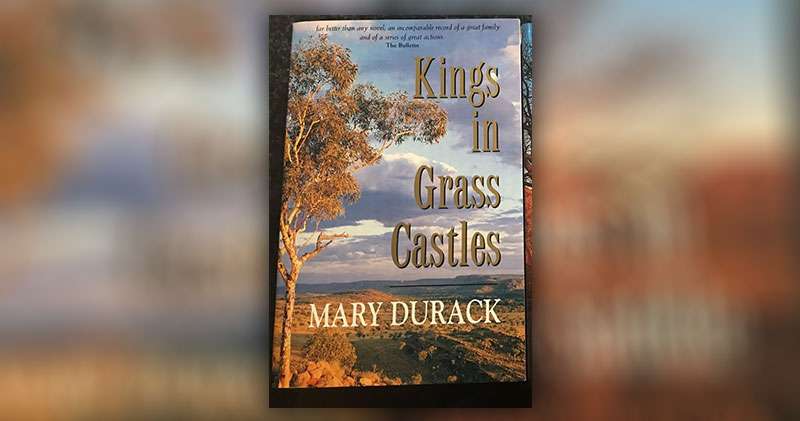
Kings In Grass Castles
11 December 2024
By: Centre For The Australian Way Of Life
Mary Durack, 1959
Mary Durack’s Kings in Grass Castles (1959) is also an intensely imaginative piece of non-fiction though its use of fictionalising technique is at an opposite pole to Jeannie Gunn’s in something the same way that Robert Hughes’ The Fatal Shore has little in common with Helen Garner in Monkey Grip or The First Stone. Kings in Grass Castles is not a sustained exercise in self-portraiture with an unreliable narrator rendering self- consciousness with a shifting self-doubt and glimpses of an unloved revelation in the mirror. It is in fact a work of literature because it is such an epically realised work of history even though it transcends the genre of which it is a distinguished example by virtue of the grandeur which allows for vast tonal range, the variegation of the voices that blend into it, and its tremendous variety of colouration and tone.
Apart from anything else, this is the supreme pioneer book which delineates with great scope and detail the way in which Patrick ‘Patsy’ Durack establishes a vast empire of cattle stations, some of them the size of a smaller nation. There is a tremendous exhilaration in the way we see the Durack patriarch quest for gold and cross rivers and subdue Western Queensland and hit the Kimberleys like the revelation of the pioneering spirit writ epical and all-conquering. In one scene he says to a couple he wants to transit to grab land: “It’s not a property I’m offering you. It’s a principality.”
In 1883 Durack and his partners launched an historic trek to take cattle from their properties overland to the Kimberley in WA. It took two-and-a-half years and they lost half their stock, but it opened up the area for cattle grazing and a port was established at Wyndham to service the district.
Patsy the cattle breeder man of vast golden capital is ‘a prince’, if we are to invoke the Irish idiom that has become part of the older Australian vernacular. And the shadow of Ireland—the potato famine that reduced families to skeletons—is invoked together with the ancient Gaelic spirit of Brian Boru and Cuchulain and the crime by perfidious Albion of dispossessing a Catholic aristocracy from which Patrick Durack derived and from which he seems some kind of throwback.
But this rich and marvellous work of history unearthing a world of which we scarcely dream is also a tragic story and therefore in a paradoxical way a story of failure, whatever hubris it was that drove Patsy Durack to let his reach exceed his grasp. His beloved wife is dead and he is beyond tears and the blacks wailed and his Aboriginal retainer Pumpkin stays by him but at the end his beloved Mary, four years’ dead, comes to him in dreams.
All little kings in their grass castles, Mary, and the wind and the water sweeping them away… Pumpkin, the best friend I ever had.
Patsy Durack is left bereft although he has always believed in his wife’s sense of a higher dominion despite the sorrow and humiliation (or rather as the deeper meaning which is continuous with it).
“That I who have spared so many from the humiliation of debt should be unable to meet my own is the greatest affliction the Lord could have sent me,” he said.
To which grandmother replied as always in terms of stress and
trouble, “But affliction, you see, my dear, is the love of God. For how can you wear a crown if you have not borne a cross.”
You do not expect to read the story of an Australian pioneer—utterly and eloquently articulate—who hears the call of the Sidhe (the ‘fairy folk’ in Irish mythology) and is also in love with a strong religious woman who tells the beads of her rosary. There is a ruminative melancholy that co-exists with his esprit de corps.
The husband and wife commune in a world of complex and somehow contraindicated possibilities:
“But you got where you wanted, my dear,” Grandmother reminded him. “You’ve made money.”
“Was it for the money then?” Grandfather asked. “Now that it has come I cannot be sure.”
It puzzled his wife how a man who had done so much with such speed and efficiency seemed almost incapable, at this stage, of any action whatever.
There is a tremendous brio in the portrait by Mary Durack (1913-1994) of her grandfather Patrick Durack (1834-1898), which must be one of the greatest portraits ever written of an uneducated man who was always a man of great panache and style:
“Sooner or later we’ll all have to walk out of this country,” the pessimists predicated.
“When I walk out,” said Grandfather, “I go in a four-in- hand, and I go a rich man.
So help me God.”
Part of the perspective trick with Kings in Grass Castles is that it is a wholly convincing portrait of a great pioneering spirit, grabbing land as if there were no tomorrow—a figure, if you like, who might in his pioneering way, his old Australian way, be thought of as a great capitalist. But this delineation of his success and failure as an entrepreneur is liable to be read by the business layperson for all its other qualities, for its notation of a circumambient world. He sends his sons to Saint Patrick’s College, Goulburn, but he reacts almost like the high-handed patriarch he partly is when they suggest they might like to matriculate and go to university.
I had not in mind for either of ye the law or the classics for a career of which Dr. Gallagher has spoken to me but would have yere names associated with pioneering of new country as is in the blood, dear children, and yere people always on the land as others are associated with professions such as doctoring and the Law which is not in yere blood…
This is as I would have it, dear children, but if it is the will of God and the considered judgement of yere teachers that ye go for the professions then I will be standing down but at this time with all the arrangements to be made forgetting the cattle on the road and running the stations at the same time as my other business I must have Michael at the first chance.
This has a sweeping authority—never mind the spelling—which is a bit scary and it is also blackmail, but is there any figure in the annals of Australian history with a more distinctive voice?
There is a tremendous brio in the portrait, one of the greatest ever written of an uneducated man who was always a man of great panache and style. Part of the perspective trick with Kings in Grass Castles is that it is a wholly convincing portrait of a great pioneering spirit, grabbing land as if there were no tomorrow—a figure, if you like, who might in his pioneering way, his old Australian way, be thought of as a great capitalist. But this delineation of his success and failure as an entrepreneur is liable to be read by the business layperson for all its other qualities, for its notation of a circumambient world. Patrick (pictured below) sends his sons to Saint Patrick’s College, Goulburn, yet reacts almost like the high-handed patriarch he partly is when they suggest they might like to matriculate and go to university:
Now ye have all had a good education and have learned a grate [sic] deal and may think yere father an ignorant old fool but in experience I have learned a few
things that could be of use to ye all and I would want ye all to make good and do well in life but to remember that everything in life is not in the making of a fortune or in the losing of it … A man may still had led a profitable life and have little proof of it in his pocket.
He is described at one point as mercenary but this is immediately qualified because it doesn’t quite fit his intoxication with money but Durack is so good at capturing the pioneering enterprise because she understands the romance that attends it.
This is one of those books—they are rare—that can tell us all about the crucial convictions of Caroline Chisholm, the Catholic, and John Dunmore-Lang, Protestant and anti-Papist. She indicates in passing but surefootedly Henry Parkes’ as Premier anti-education stance and how the Catholics and the Anglicans finally won the day with church schools (though Parkes as Premier also established secular government high schools). She has a lovely moment when one of Patrick Durack’s brothers-in-law, the ‘devil-may-care’ Dinny Skeahan, proffers a challenge to the local parish priest:
Dinny, primed with hard liquor and no respecter of persons at the best of times, challenged the priest to a fight, whereupon Father Dunham, to the surprise and joy of the community, not only took on the hot-headed Irishman but promptly laid him flat. Dinny, scrambling from the dust amid the jeers of the onlookers, came adroitly to his own defence. “And what sort of a man is it atall [sic] would be hitting a praist?”
And she tells us how the Catholic Bishop (Matthew) Gibney (1835-1925) railed against the treatment of the blacks:
‘Doomed to disappear!’ Blessed phrase. Over how many bloody outrages, over what an amount of greed on the part of some, weakness on the part of the Government, and apathy on the part of the public does this convenient euphemism throw a thin but decent disguise …
Nor is it solely, nor chiefly because the easily acquired vices of the white man prove fatal to them.
Their misfortune is that they stand in the way of unchecked spread of flocks and herds.
Insatiable earth hunger and monstrous unscrupulousness are main factors in that process of removal of which they are the victims.
They disappear rapidly on the outskirts of civilisation because in such a situation the white man is practically beyond the cognisance of the law, shoots straight and shoots often.
It is characteristic of Durack that she knows “the same man [Gibney] in 1880 had entered the blazing inn at Glenrowan where Ned Kelly and his band had taken their final stand, in order to render the last rites to the dying outlaws.”
Patrick Durack liked the blacks and treasured his relationship with Pumpkin, his black retainer. Sometimes his descriptions of the Aborigines are off-putting, like this with an extra bit of romantic rhetoric from Durack:
“It is the blessing of Almighty God they are kindly and child-like savages,” Grandfather said and would never alter his estimate even when the simple people had turned fiends at last in the blind thrusts of bewildered rage.
Basically though he had nothing but contempt for the punitive expeditions often conducted by native police which he sees as analogous to the English persecution of the Irish. Durack is sometimes elegaic about the blacks, sometimes eloquently, and she also has vivid and ghastly descriptions of the shackling of children, the floggings as a punishment for killing a sheep, the horrific hanging where a man being hanged grabs the rope with his strong teeth for as long as he can.
No indigenous person who was tried on the retributive charges was acquitted. Although Durack’s language is romantic and colourful and very far from contemporary fashion, she indicates the horror in a way which will make white Australians ashamed and her portraits of the Aboriginals Patrick Durack got close to, like Cobby and Pumpkin—to whom he gave a Saint Christopher Medal— are detailed and convincing.
So is the whole of this multi-textured masterpiece. It is a starting, burningly eloquent recapitulation of a lost history. It is a book about the soaring pastoralism of the 19th century, the way the squatters owned vast tracts of country and the way some of the rich could use small farmers as dummies for their empires. But it covers all manner of material such as Patrick Durack’s loyalty to Parnell in Ireland, and the author’s father’s enthusiasm for Fitzgerald’s Rubaiyat of Omar Khayyam translation, whereas the patriarch dismisses him as a ‘heathen’ nincompoop.
There’s also in the vast informal talk that constitutes so much of the overheard quality of this strange family history that somehow encapsulates a world, this statement from old man Durack that might have been a message to Jeannie Gunn before the letter:
“It’s no country for white women, Patsy.”
“If it’s no country for the women then what use is it to the men?” Grandfather demanded…
“But a country without women, I cannot picture it! It will be a sad, barren place until they come.”
Not many books have captured so much of the glory and the loneliness of Australia as Kings in Grass Castles. Not many are such detailed accounts of both the heroism and the catastrophe of the pioneering spirit. This book is so Irish, so Catholic, so familial, so steeped in blarney and rhetoric, so echoingly grand. Yet each of these elements come together, even the sense of the Aborigines as people who must forsake the dreaming and whose walkabouts are foreign things to the whites–– all those things come together in a work so haunting it is hard to acknowledge it as history. But it is history of the grandest and the most compelling kind and the fact it is also tragic while shining intimations of faith enrich it but does not diminish the power of its architecture. Pushkin said of Gogol, “God, how sad Russia is”—and it’s the kind of remark that can only be made about a work that encompasses a world. It’s true though. Among very few works in our history, Kings in Grass Castles makes us say of all of this pioneering blood and thunder in a dry land, “God, how sad Australia is.”
The commentary by literary critic Peter Craven first appeared as “Pioneers’ Influence Ripples Across Time” in two parts, in the Autumn 2023 and Winter 2023 editions of the IPA Review.
