
Song of Australia
25 August 2025
By: Centre For The Australian Way Of Life
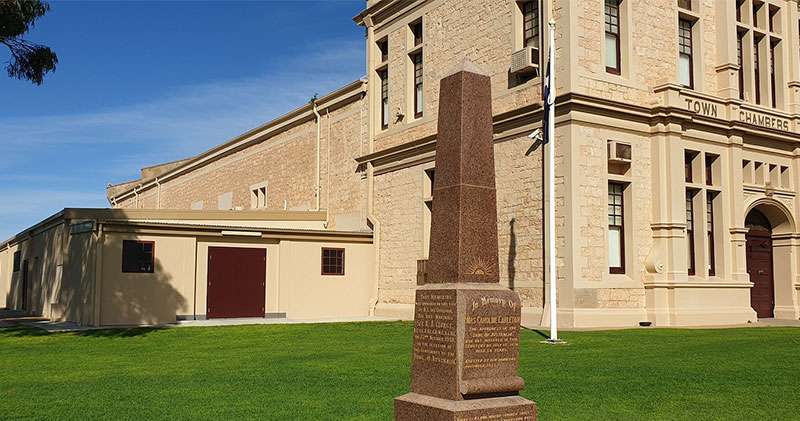
Song of Australia (1859), Caroline Carleton
At a trivia night you might be asked, “What were the four songs Australians could vote for in the 1977 plebiscite to choose our new national anthem?” You should get ‘Advance Australia Fair’. I mean, it is the current anthem. I reckon you’d get ‘God Save the Queen’ too, being the pre-’77 anthem. A not too wild guess should nab you ‘Waltzing Matilda’. But ‘Song of Australia’? That’ll be a struggle – unless you’re South Australian.
When national votes were counted, Song of Australia was last. Except in South Australia, the song’s home state. There, it was top of the pops. But the rest of the country, which barely knew the song, ignored it.
Despite being in this canon as a poem, Song of Australia was written with the intention of being lyrics to a song. Caroline Carleton, in 1859 working in Adelaide’s West Terrace Cemetary that her husband Charles managed, had heard about a Gawler Institute competition. It called for a patriotic poem that a composer could then set to music. She sat down amongst the gravestones and scrawled the words, “There is a land where summer skies are gleaming…” On she went, celebrating forests “flushing” in “rosy light”, hills and plains that make wine for “quaffing to thee and thine” and “a land where homesteads peep from sunny plain and woodland steep.”
Despite being the wife of a gravedigger, Caroline was no pleb. Born in England in 1811, she was highly educated, could speak French and Italian fluently, had a decent grasp of Latin, and played the pianoforte and harp. Given her upbringing, Song of Australia’s patriotic optimism might be expected. But Caroline had endured her share of suffering: in 1839, she and Charles lost their two children to illness on their sea voyage to Australia. Once down under, Charles, a medical student when Caroline met him, made one desperate career move after another, finally working in the West Terrace Cemetery, until he was buried there in 1861, leaving Caroline without income.
Two years before that, Caroline, under the pseudonym ‘Nil Desperandum’, appropriate given her experiences and the poem’s sentiment, entered Song of Australia in the Gawler competition – and won, including the prize of 10 guineas, which would have been a huge fillip for her and Charles. It’s not surprising Caroline entered the competition under a pseudonym; hers was the era when Australian women were just starting to be published; her big win was also a victory for female writers. Carl Linger won the next stage of the competition – a tune for the victorious poem – and Song of Australia was complete.
Upon being published as the winner, Caroline’s poem didn’t please everyone. Some decried its banality, others that it didn’t reflect the era’s tumultuous international politics. Further critics noted it could as easily be describing California – and that it didn’t include any sheep. The Adelaide Advertiser came out in defence of the judges and, despite critical bemoaning, the work was later published in Caroline Carleton’s posthumous poetry collection, Bush Echoes, a volume critics would argue contain many stronger poems than Song of Australia.
But by 1924, the song so enlivened George Yates, the Member for Adelaide, that he said in Federal Parliament that it should be made our national anthem, proceeded to sing the first verse, before being howled down. The nation would, of course, echo the parliamentarians’ sentiment in 1977.
Caroline’s words for Song of Australia, however, did what the competition asked for: it provided the beat, rhythm, and simplicity needed for a patriotic anthem that a musician could set to music.

Despite her difficult circumstances, she celebrated what Australia offered, including the crack at wealth that others might be able to achieve if they batted on a better wicket than she did. Her take on this matter, however, has potentially greater resonance today than our current anthem’s idea of ‘wealth for toil’, instead intimating that if you really want to worship at Mammon’s shrine, you should be able to find enough in the ground to do so.
There is a land where treasures shine
Deep in the dark unfathomed mine
For worshippers at Mammon’s shrine, at Mammon’s shrine;
Where gold lies hid and rubies gleam,
And fabled wealth no more doth seem
The idle fancy of a dream –
Australia! Australia! Australia!
Beyond its positivity about the nation, needed at any time in our history, the poem’s greatest strength is its vibrancy and celebration of freedom. Here is a woman in a graveyard, who has no real prospects, whose voice would normally be largely ignored, writing joyfully of living under freedom’s flag, where “shackled” slaves are no more and Australians of the time, still seeing themselves as sons and daughters of Britain, can make their way independently in the world.
Along with the monument celebrating Caroline at her burial place in Wallaroo, SA, Song of Australia stands as testament to a woman’s independent spirit, her love for her country despite her suffering, and to a poem that played its part in building the runway that launched us as a nation in 1901.
This appreciation of ‘Song of Australia’ was authored by Melbourne writer and academic Heath Remington, in 2025, specifically for The Genius of Australia.
