
Voss
19 November 2024
By: Centre For The Australian Way Of Life

Patrick White, 1957
Patrick White is far and away the greatest writer Australia has ever produced in any medium and not to take stock of this would be a very sad thing indeed.
It’s only a couple of generations ago when the penny dropped that White, a toff of pastoralist stock who turned in his latter days into a raging lefty, was in fact one of the greater writers of English literature of the twentieth century. He was not the equal of Proust or the Joyce of Ulysses, he did not belong to the first eleven – but then there were a lot fewer than eleven places in any list of the very greatest fiction writers in world literature. White is the Australian who comes closest to making the team. White takes his place with William Faulkner, Vladimir Nabokov, and Samuel Beckett.
White could be an imperious and enraged figure. But he had a modesty about those things which were most precious to him.
When he won the Nobel Prize for Literature in 1973 he said he should break it into three pieces and give one to Jack Mundy the union leader he thought had saved Centennial Park, and another to Manning Clark the historian who had suggested that the Australian character came out of the tension between the English idea of uprightness and the Irish idea of humankind as larrikin and saint. In the wake of the dismissal of the Whitlam government, Clark like White, became a man of thundering jeremiads, but his broodings on the Australian character were essentialist, idealist, and far from leftist.
White’s politics in his later years’ obscures David Marr’s perceptive assessment of him on his return to Australia after the war, as having the look – you can see it in the photos – of an indomitable Australian pastoralist. He no longer looks in the substantive sense like a boy wondering who he is. He looks in the most born to rule way, like someone with the self-implacable confidence of Malcolm Fraser.
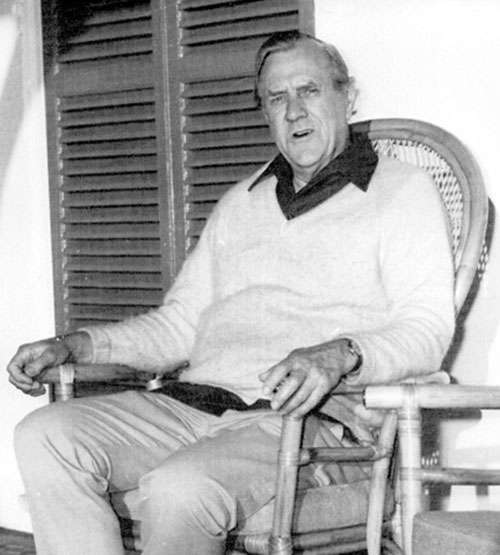
Patrick White in 1973 (source)
And – while we’re on the subject of conservative Australian leaders – it’s worth pointing out the fact, shocking to a lot of leftists when Marr’s biography revealed that in the fifties, Patrick White voted for Menzies. I remember David Marr saying to me, ‘At first I was taken aback and then I thought, ‘No, it figures.’
White himself spoke about this country’s literature as so much ‘dun coloured Australian realism’, and it’s true. For baby boomers growing up in the 1960s, there was that precocious adherence to what AA Phillips referred to, in his famous essay, as the cultural cringe whereby we internalised some inner Englishman forever detecting some bad smell in the Australian effort to fictionalise the world.
What happened to the baby boomer generation however (or at least to the markedly literary fraction of it) was that at the very moment when they were starting in their teens to read Camus, and Gide, when they were lapping up Darkness at Noon and A Portrait of the Artist as a Young Man, they stumbled on Patrick White.
It was in fact part of the same cultural moment. There were Penguin Classics of both The Tree of Man and Voss with evocative Sidney Nolan line drawings and there was also, from recollection, an Australian Penguin which quoted Al Alvarez, the famous promoter of Sylvia Plath and Ted Hughes pronouncing of Riders in the Chariot that it was writing at a level that should make most British fiction or its creators hide their heads in shame.
There was no reason to disbelieve him because Patrick White when we read him seemed to be great beyond the size of dreaming. The Tree of Man (1955) the first book after The Aunt’s Story (1948) seemed to us, a staggering work, partly because it was the literary incarnation and transfiguration of the Mister and Missus Everyman that haunted the Australian consciousness as the deepest kind of intuition that common Australian life, without literary frills and with a bush setting, was integral to our perception of the world.
Voss (1957) comes two years after The Tree of Man and is the book White’s readers tend to go to first. It is a medium length novel with considerable concentration, and it is also variegated in the kinds of writing it contains, as well as articulated with a formal intensity that is arguably unrivalled in White’s work.

Ramona Koval interviews Peter Craven for The Tree of Man v. Voss
Joseph Losey wanted to film it and a script was done by the British playwright David Mercer. Max von Sydow, the great Swedish actor, was set to play Voss at one stage, and so was Maximilian Schell, the great German Hamlet of his day. It never happened and this was a searing disappointment to Patrick White because film would have provided something commensurate in magnitude to his continent-wide conception of mighty endeavour and destruction. He had to be content with the Richard Meale opera, appropriately Wagnerian in its shadings and constructions, conducted by Stuart Challender with a David Malouf libretto. The director was White’s golden boy of the day, Jim Sharman, who had been a runaway success doing Jesus Christ Superstar and Hair.
Voss though is from the high and mighty heyday of Patrick White, and there may be a projective element in this figure who tries to conquer a continent in order to plumb the depths of himself. Voss is intimately related to White’s decision to live in and stay in Australia because, as he said, he wanted to take on a country, and the only one he knew well enough was the land he had been born in.
It is an extraordinarily ambitious novel because White succeeds in creating a series of worlds that overlap and yet retain their distinctness. It is a novel that encompasses refined Sydney life through the world that surrounds, and half sustains Laura Trevelyan, it presents the quest of the visionary Johann Ulrich Voss in all his worldly and unworldly zeal: he is a natural leader, a genius of enterprise, and he is at the same time someone whose dream of himself is enacted like a fated tragedy and self-realisation, and all this is combined with extraordinary zigzagging juxtapositions.
On top of the Jane Austen aspect of the world of Laura and the Bonners there is her telepathic union with Voss, her soul marriage, and then there is the relationship with her servant Rose and Rose’s child. And Voss’s expedition takes in a wholly credible range of characters from the agonised poet Frank Le Mesurier to the sturdy ex-convict Judd with the decent Christian gentlemen Palfreyman the ornithologist in-between.
Voss is a book that juggles a number of incandescently bright balls in a way that seems, on the face of it, impossible. Yet it does so with a consistent brilliance that makes the reader feel that this feat of narrative and stylistic juggling is entirely natural. And all of this transpires in a style of very high late ‘modernist’ impressionism – a style which has an affinity, say, with the highly coloured prose style of William Golding, whether in The Lord of the Flies or The Spire, in a deliquescent sea of language full of savage and scarlet hosannas of revelation.
Voss begins with Rose the harelipped servant girl, who we eventually discover was transported as a convict for infanticide, telling young Laura Trevelyan that the German gentlemen has arrived and Laura giving Voss port. Soon in their successive sparse meetings they are exchanging intimations of what life might mean while the social comedy, the Jane Austen social caper, bubbles around them, complexly and expertly.
Voss puts together the team that will help him discover whatever inland sea the deadly and dry continent may contain and he also consistently articulates the apprehension of whatever perdition or paradise may lurk in an expedition that is also a journey into the depths of the self. Laura is at one with him on this and the magic of this telepathy is brilliantly managed, at one leap. She also adopts the new child of Rose who has become pregnant again and dies soon after.
The expedition is drenched with colour of the most vivid and realistic kind and the characters are sharply differentiated. There is the simple boy Harry Robarts devoted to Voss and there’s Frank Le Mesurier who in a strange but successful way actually writes poetry with abstractions that fall like body blows in the manner of Rimbaud. There’s Turner, a cynical good for nothing and Ralph Angus a decent young upper-class gent and there’s Judd, the very formidable tough guy, who has been flogged as a convict and endured every kind of hell but who is, in a powerfully rendered way, a natural born leader of an opposite kind to Voss. Palfreyman, the good Christian ornithologist, is a superb portrait of the gentle kind of gentleman, and there are the Aboriginals, apart, gentle too, inscrutable but who are not centrally focused except in terms of the plot where they are presented vividly and with sympathy: they represent an aspect of the land, the continent that Voss with his tragic grandiosities (which are nonetheless genuinely grand) will never conquer.
The Institute of Public Affairs was right to include Voss as part of its Australian canon. In fact, it also belongs to a narrower and more elevated canon than that because it is one of the greater novels in English since the Second World War. If you want to ask the question of how it might relate to a hypothetical view of Australian life, well, it appeared in 1956, a few years after Arthur Calwell introduced a scheme of immigration that was not simply Anglo-Celtic and this was continued by the Menzies government. Voss provides a hero who is not only foreign but German (a bare decade or so after the war) and it is also a testament to the fact that Australia produced people like Patrick White who read French and German at Cambridge.
If we ask the question, why a conservative should be interested in White when he became such an extravagant and denunciatory man of the left the answer is ‘Why not?’ Our politics will become self-disablingly narrow if we do not realise that we must embrace great art and literature wherever it comes from. What Karl Marx took from Balzac was his extraordinary recapitulation and symbolic dramatisation of reality, not his politics. When there was a fuss about Ezra Pound winning the Bollingen Prize for poetry after he had broadcast propaganda against America during the Second World War, George Orwell said that although he had always considered Pound a bogus poet there was no reason a poet should not win a prize just because his politics were anathema.
It is in fact a novel that reflects a very confident cosmopolitan culture. Each of White’s novels from ‘The Aunt’s Story’ to ‘The Twyborn Affair’ wrestle with the absurdity of the colonial, and more precisely, the dominion displacement by which, as Northrop Frye used to say, the old ontological question ‘Who am I?’ is displaced into a kind of geographical absurdity like ‘Where is Here?’ It is undeniable that Patrick White, however, in Voss, as in The Tree of Man, gives the most concerted power of imaginative achievement to tallying the ‘where is here’ absurdity with a comparable and transfiguring sense of ‘who am I.’ Voss represents the tragic extremity of what it means to confound these questions.
This commentary by literary critic Peter Craven first appeared in a longer article on ‘The Genius of Patrick White’ in Essay for Australia, a publication of the Centre for the Australian Way of Life. The original article can be found here.
