
Wake In Fright
9 January 2026
By: Centre For The Australian Way Of Life

You know a film is truly seminal when it finds its way into the vernacular: a ‘Wake in Fright moment’ is now Australian for being confronted by menacing people, alien to you, in a harsh setting you can’t escape. At time of writing, a 4K-resolution version of the film was screening in cinemas around the country, introducing new audiences to its visceral portrait of outback Australia, while offering those who know it a sharper view of the sweat and gore.
Wake in Fright saw screenwriter Evan Jones adapt Kenneth Cook’s eponymous 1961 novel, but it was a box office failure upon release, due largely to scenes using a real kangaroo cull and the disdain viewers held for its grubby portrayal of Australia. However, it was nominated for the 1971 Cannes Film Festival’s Palme d’Or, is one of only two films to screen twice at the Festival and was critically acclaimed.
The actual film was lost for a period but Wake in Fright went on to become an Australian classic, clearly influencing other Australian classics such as Mad Max, especially through its desert car roo hunt scene featuring a young Jack Thompson. Legendary director Martin Scorcese has used motifs from the film in his work and said “Wake in Fright is a deeply – and I mean deeply – unsettling and disturbing movie. I saw it when it premiered at Cannes in 1971 and it left me speechless.”
Directed by Canadian Ted Kotcheff, it tells the story of John Grant, a school teacher bonded to the NSW Education Department. Under the terms of his $1000-bond, big money for the time, the Department has forced him to teach in a remote school, so remote there’s just a pub and train station for company. Grant is deeply frustrated, but the summer holidays are upon him and he can visit his beautiful girlfriend in Sydney. But to get home he must take the train to the rural city of Bundanyabba, or ‘The Yabba’, and stay overnight before the next train.
An educated, handsome, and refined man, Grant turns up his nose at the locals at the pub, before being lured into the excitement of a two-up game at the back of the RSL Club. He wins big, leaves for his hotel room – then realises if he gambles what he’s won on a final coin toss, he could release himself from his bond and teaching.
He loses the lot and, broke, hot, and desperate, he spends the weekend in Dante’s fourth circle of hell, though by Monday morning he’s spun through the seventh.
Chips Rafferty’s character Jock Crawford, an odd blend of police chief and US Marshall, is Grant’s first guide through this outback Gehenna. He introduces him to the need to drink relentlessly and, in the pub, indoctrinates him into the town’s religion, the Anzac myth. Suddenly, despite the absence of Anzac or Remembrance Day, a display is unveiled, the entire bar stops and stands to attention as a recorded voice tells of the need to remember the Anzacs. Everyone chants the response and are then released to continue drinking and gambling. It’s like an Islamic call to prayer – followed by a return to hell.
In the RSL club, Jock leaves Grant to his second guide, Donald Pleasence’s character “Doc” Tydon, an alcoholic, cultured, bi-sexual medical practitioner who has fled Sydney and lives without money. It’s clear Doc is who Grant might become if he stays in the Yabba. In Pleasence’s bravura performance as Doc, his first words to Grant – and their subsequent exchange – represent Grant’s turning point:
Doc: All the little devils are proud of hell.
Grant: You mean... you don't think The Yabba is the greatest little place on Earth?
Doc: Could be worse.
Grant: How?
Doc: [drinking] Supply of beer could run out.
Grant: Why did you say that?
Doc: Say what?
Grant: About them being proud of hell.
Doc: Discontent is the luxury of the well-to-do. If you've got to live here, you might as well like it.
In a high-octane 48-hours, Grant learns to like it, be transformed by it, hate it, and finally discover there’s no escape. He drinks non-stop, fails to have sex with the town ‘slut’ as he vomits, shoots roos, fights another roo bare-handed before slitting its throat, gets a gun for a gift, dodges Doc’s advances, escapes on foot and eats rabbit from an open fire, then finds a truckie willing to take him back to the ‘city’. Asleep in the back of the truck, Grant wakes to find he hasn’t arrived in Sydney, he’s back in the city of Bundanyabba. His gun now comes in handy, but not handy enough – and he ends up spending the rest of his summer break in hospital, before returning to his outback school.
Wake in Fright is not just an Australian classic because it was the first film to show what is now a cinematic cliché: hard-arsed outback life, where women are subjugated, the majority of men are mindless, and life disappears in a haze of heat, booze, violence, gambling, and despair. This surface-level portrait is powerful enough, but there is much more going on in this highly intelligent piece of cinema.
As Scorcese’s reaction intimates, Wake in Fright is a classic film full stop: mythic in scope, it makes for a high energy physical and philosophical ride. Grant’s journey into the underworld and his interactions with the ‘demons’ he finds there sees the film expound upon questions of morality, sexuality, masculinity, power, class, and what makes for civilisation itself. It’s a vital piece of Australian – and world – cinema that blazed a trail through the outback that hundreds of films have followed, but none with its urgency or poignancy.
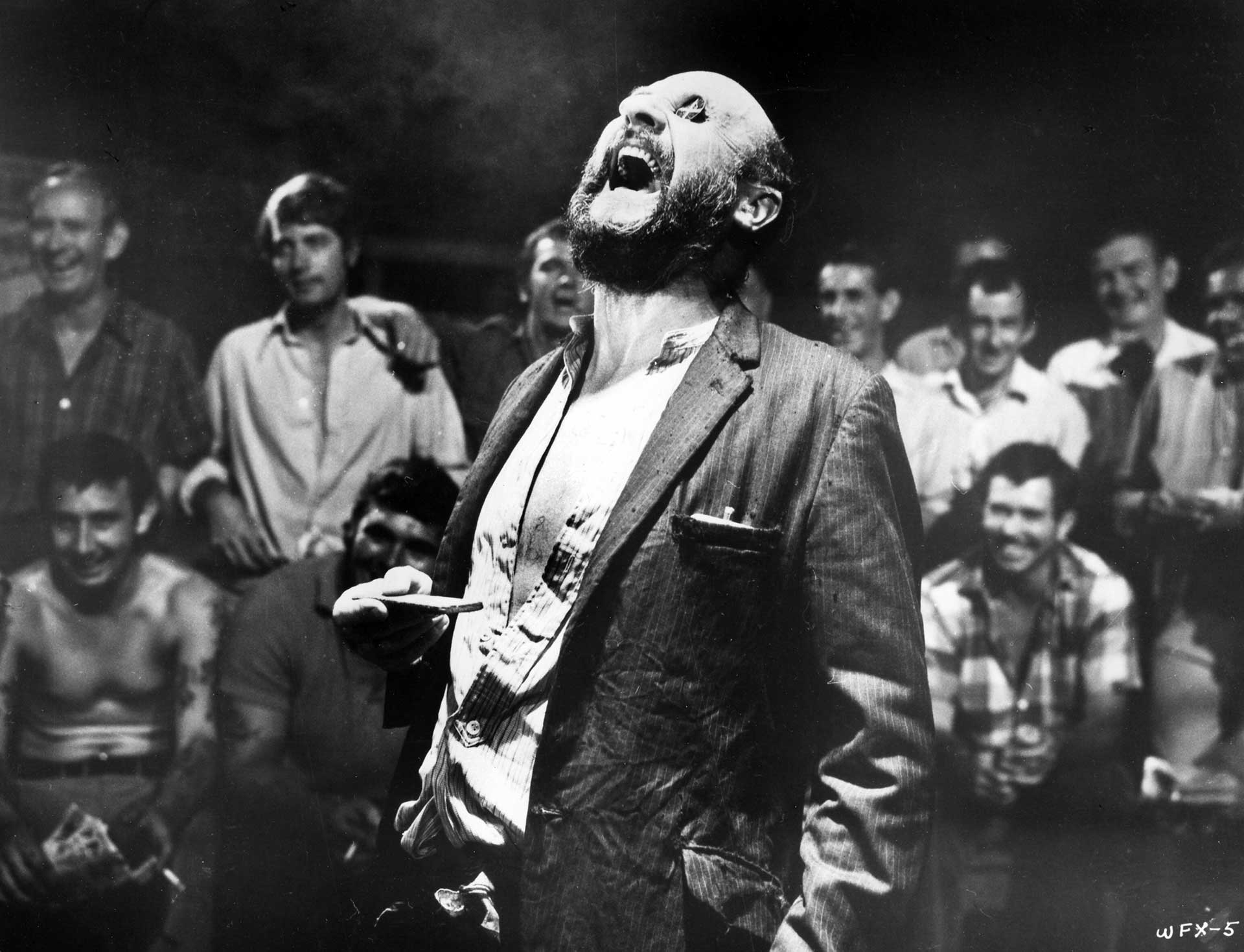
DONALD PLEASENCE in WAKE IN FRIGHT (1971), directed by TED KOTCHEFF
Photos courtesy: MovieStillsDB
This appreciation of Wake in Fright was authored by Melbourne writer and academic Heath Remington, in 2026, specifically for The Genius of Australia.
For commentaries on other works in the IPA’s Canon, go to the Index at The Genius of Australia.
